About
Flintknapping is the practice of shaping stone by removing flakes in a controlled way, usually to create sharp edges, tools, or tool blanks. In archaeology, this process is often called lithic reduction, and it plays an important role in understanding how people in the past made and used stone tools. Because stone artifacts survive so well in the archaeological record, they are one of the most important sources of evidence for studying prehistoric lifeways.

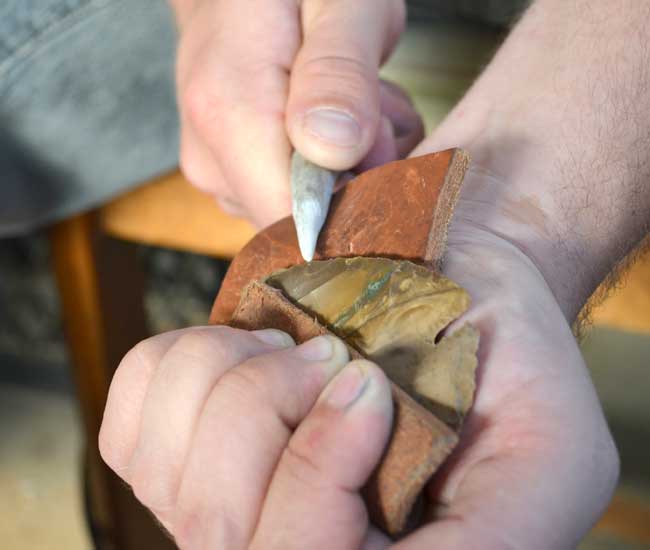
At its most basic level, lithic reduction involves taking a piece of workable stone and removing flakes from it to create useful edges, shapes, or finished tools. In archaeological terms, the stone being worked is often called a core, while the removed pieces are called flakes. Groups of flakes and fragments are often referred to as debitage, and pieces that have been intentionally modified along their edges are called retouched tools.
Most flaked stone tools were made through controlled conchoidal fracture, a type of break that occurs when force is applied to a brittle material in a predictable way. This is why certain stones, such as flint, chert, and obsidian, are especially important in lithic technology: they break in ways that allow a knapper to detach sharp flakes and gradually shape a tool.


For archaeologists, flintknapping is more than just making stone tools. It is also a way of understanding the past through experiment and observation. Researchers learn about lithic technology through several kinds of evidence, including mechanical studies of fracture, experimental archaeology, ethnographic comparison, and clues from archaeological contexts. In that sense, learning the basics of flintknapping helps students better understand not only how stone tools were made, but also how archaeologists interpret them.
This website is meant to serve as a general introduction to flintknapping and lithic reduction techniques. Whether you are an archaeology student, a beginner interested in experimental archaeology, or simply curious about how people shaped stone in the past, this page is designed to introduce key ideas, terms, and techniques in an approachable way. The goal is not to replace hands-on instruction or formal archaeological training, but to provide a starting point for understanding the basics of stone tool technology and why it matters.